
How Soon After a Tooth Extraction Can You Get a Dental Implant?
A dental implant can sometimes be placed on the same day as a tooth extraction, but other patients may need to wait several weeks or months. How soon after tooth extraction you can get an implant depends on the condition of your gums, the amount of available jawbone, whether infection is present and the stability an implant can achieve.
The right timing is not necessarily the fastest option. It is the approach that offers the best conditions for healing and long-term implant stability.
At OMG Perio in Hamilton, dental implant planning includes an assessment of the tooth, surrounding bone and gum tissue to determine which treatment approach is appropriate.
Can You Get a Dental Implant Immediately After Tooth Extraction?
Yes, immediate dental implant placement is possible for suitable patients. The implant is inserted into the jawbone during the same appointment in which the natural tooth is removed.
Traditionally, patients often waited for the extraction site to heal before receiving an implant. Modern implant techniques now make immediate placement possible in selected circumstances.
However, removing a tooth leaves an empty socket. The implant must be positioned securely within the surrounding bone, which may require careful planning to achieve adequate initial stability.
Immediate placement may be considered when:
- Sufficient healthy bone remains around and beyond the extraction socket.
- The surrounding gum tissue is in suitable condition.
- The extraction can be performed while preserving important bone structures.
- Any existing infection can be appropriately managed.
- The implant can be positioned and stabilized without compromising the final restoration.
An immediate implant is not necessarily the best option for every extraction. If the supporting bone is too thin or damaged, allowing the area to heal or performing a bone graft may be more appropriate.
Immediate, Early and Delayed Implant Placement: What’s the Difference?
Dental implant timing generally falls into three categories: immediate placement, early placement and delayed placement.
Immediate Implant Placement
An immediate implant is placed during the tooth extraction appointment. This can reduce the number of surgical appointments and shorten the overall treatment process for suitable candidates. For example, a patient requiring removal of a fractured tooth may be eligible for immediate placement if enough supporting bone remains and the implant can be positioned correctly.
Even when the implant is placed immediately, the final dental crown may not be ready that day. The implant often needs time to integrate with the surrounding bone.
Early Implant Placement
Early placement allows some healing after the extraction before the implant is inserted. Depending on the condition of the extraction site, this may occur approximately four to eight weeks after extraction, once soft-tissue healing has progressed. Another early-placement approach allows roughly 12 to 16 weeks for partial bone healing.
This approach may be recommended when additional healing is needed to improve the condition of the surrounding tissues.
Delayed Implant Placement
Delayed placement gives the extraction site more time to heal before implant surgery. Some treatment plans involve waiting several months, particularly when bone rebuilding or resolution of significant disease is necessary. Later placement may take place more than six months after extraction, depending on the clinical circumstances.
The additional healing period is not necessarily a disadvantage. For some patients, it provides a more suitable foundation for implant placement.
The key difference is that immediate placement prioritizes treatment efficiency when conditions are favourable, while early or delayed placement allows more tissue healing when needed.
What Determines Whether Same-Day Implant Placement Is Possible?
The decision is based on more than how quickly the patient wants a replacement tooth. A periodontist evaluates several clinical factors before recommending immediate or delayed placement.
Available Jawbone
Dental implants need adequate bone to support their placement and long-term function. An extraction site may have reduced bone volume because of longstanding periodontal disease, previous infection, trauma or natural changes following tooth loss. Even if the surrounding gums appear healthy, the underlying bone may require closer examination.
At OMG Perio, digital planning and cone beam computed tomography (CBCT) imaging can help assess bone structure, available space and nearby anatomical features.
Infection and Gum Health
An infected or severely damaged tooth does not automatically rule out immediate implant placement. However, the type and extent of infection matter. Active periodontal disease, significant tissue damage or an extraction site that cannot be adequately cleaned may make a different treatment sequence preferable.
The goal is to establish healthy, stable conditions before the implant is expected to function as a replacement tooth.
Location of the Missing Tooth
Replacing a front tooth can involve different planning considerations than replacing a molar. Front teeth are particularly sensitive to changes in gum contours and appearance. Back teeth experience substantial chewing forces and may have larger extraction sockets or more complex root anatomy.
These differences influence implant positioning, bone requirements and the type of temporary restoration that may be appropriate.
General Health and Healing
Smoking, diabetes control, certain medications and medical conditions can affect surgical planning and healing. These factors do not automatically prevent someone from receiving an implant, but they should be reviewed during consultation.
When Is Bone Grafting Needed Before a Dental Implant?
A bone graft may be recommended when an extraction site does not have sufficient bone volume or suitable dimensions for the planned implant. After a tooth is removed, the jawbone surrounding the socket begins to remodel. Some loss of ridge width and height is normal during healing.
For patients considering future implants, the condition of that bone is particularly important.
Socket Preservation After Extraction
Socket preservation is a procedure in which bone grafting material is placed into an extraction socket to help limit changes in the jawbone during healing. It may be recommended when an implant is planned for a later date, especially where preserving the existing ridge shape is important.
Socket preservation can reduce bone loss, but it does not completely prevent natural changes or guarantee that additional grafting will never be required.
Bone Grafting Before Implant Placement
Where significant bone loss has already occurred, a separate grafting procedure may be necessary. The graft provides a framework that encourages new bone formation as the area heals. Some grafts can be performed at the time of implant placement. Others require a separate healing period before implant surgery can proceed.
Patients with inadequate bone support can explore OMG Perio’s bone grafting procedures to better understand the treatment options available.
Does Getting an Implant in One Day Mean You Leave With a Finished Tooth?
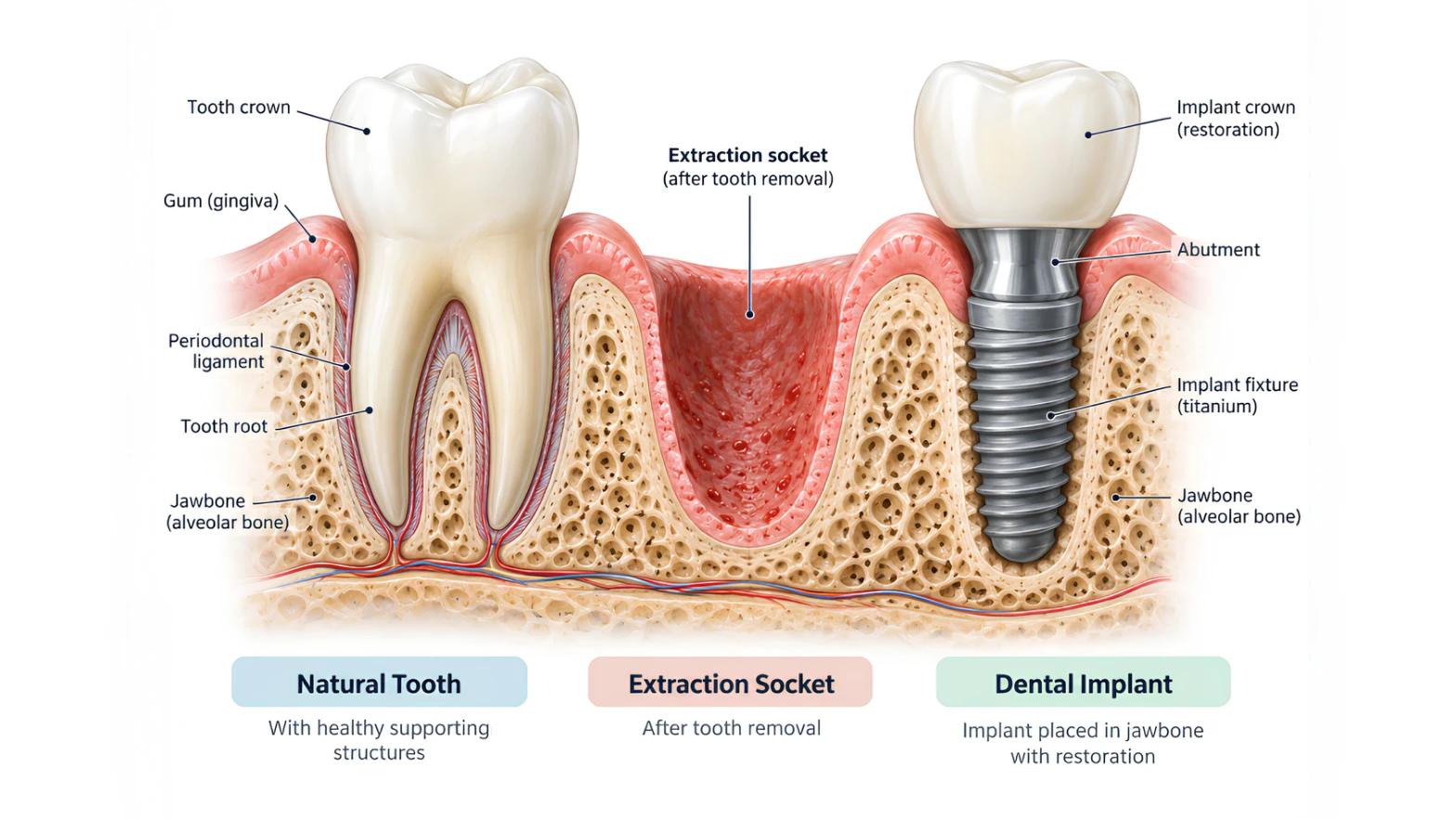
Not necessarily. Implant placement and delivery of the final replacement tooth are two different stages of treatment. A dental implant is the artificial root positioned within the jawbone. The visible replacement tooth is generally a crown attached to the implant through a connecting component.
Following placement, the implant undergoes a biological process called osseointegration, during which bone develops a stable connection with the implant surface. This integration is essential for long-term function.
In selected cases, a temporary tooth can be attached soon after the implant is placed. This approach is often called immediate restoration or immediate loading, depending on how the temporary restoration functions. An immediate restoration may be designed to avoid significant biting forces while healing takes place.
OMG Perio offers Tooth in a Day dental implant treatment for suitable patients. Eligibility depends on the clinical findings and the planned restoration. Patients should not assume that a temporary tooth and a final crown are interchangeable. The treatment team will explain when the implant can safely support normal chewing and when the definitive restoration will be fitted.
How Long Does the Entire Dental Implant Process Take?
The total treatment timeline depends on the condition of the extraction site, the type of implant procedure and whether additional treatments are necessary. For a straightforward case, implant placement and restoration may be completed over a relatively short period. More complex cases requiring bone grafting, infection management or extensive healing may take several months or longer.
The treatment process may include:
- Assessment and planning: Examination, imaging, medical history review and treatment recommendations.
- Tooth extraction: Removal of the damaged or non-restorable tooth.
- Healing or bone grafting: Performed when the extraction site requires additional preparation.
- Implant placement: Positioning of the implant within the jawbone.
- Osseointegration: Allowing adequate healing and bone integration before full function.
- Final restoration: Placement of the crown, bridge or other implant-supported replacement.
Not every patient follows these steps in the same order. Immediate-placement cases may combine extraction and implant surgery, while grafting can sometimes occur during the same procedure. The most useful timeline is the one developed for your specific treatment plan rather than a general estimate.
What Happens if You Wait Too Long After Tooth Extraction?
Waiting to replace a missing tooth may lead to changes in the jawbone and surrounding teeth, although the extent varies considerably between individuals. Once a tooth is removed, the bone that previously supported its root no longer receives the same functional stimulation. Over time, the ridge may become narrower or lose height.
Neighbouring teeth can also gradually shift toward the empty space, while the opposing tooth may move further into the gap. These changes do not mean an implant becomes impossible. They may, however, make treatment planning more complicated. Patients who are not ready for immediate implant surgery can still benefit from discussing future replacement plans before extraction.
A consultation about tooth extraction and replacement planning can help identify whether preserving the socket or arranging treatment in stages would be beneficial.
Planning Dental Implant Treatment in Hamilton
The best time to plan a dental implant is often before the tooth is removed. Early assessment allows the periodontist to evaluate whether the tooth can be preserved, whether immediate implant placement is suitable, and what steps may help maintain the bone and gums for future restoration.
At OMG Perio in Hamilton, implant assessments can involve digital imaging and individualized surgical planning. The practice provides treatment for single missing teeth as well as more complex implant cases.
Patients considering replacement of an extracted tooth can explore the clinic’s dental implant treatment options in Hamilton.
If your dentist has recommended an extraction, or you recently had a tooth removed, an implant consultation can clarify your options before additional bone or tooth-position changes occur.
Frequently Asked Questions
Can I have a tooth extracted and an implant placed on the same day?
Yes, some patients can receive an implant during the same appointment as their extraction. The decision depends on the available bone, condition of the extraction socket, infection status and whether the implant can achieve adequate stability.
Is it better to get an implant immediately or wait until the socket heals?
Neither approach is automatically better for every patient. Immediate placement may shorten treatment in suitable cases, while allowing additional healing can provide advantages when bone, gum tissue or infection conditions need to improve.
How long after extraction can I get an implant if I need a bone graft?
A bone graft may require several months of healing before implant placement, although some grafting procedures can be combined with implant surgery. The exact interval depends on the graft’s location, extent, material and the patient’s healing response.
Can I get a dental implant if the extracted tooth was infected?
An infection does not always prevent implant placement, but the extraction site must be evaluated carefully. Your periodontist will consider whether the infection can be managed appropriately and whether healthy tissue and sufficient bone remain.
Will I have to go without a tooth while my implant heals?
Not always. Depending on the tooth location and treatment plan, a temporary removable or fixed replacement may be available while healing takes place. The temporary option must be designed so it does not interfere with the extraction site, graft or implant.